The Boundary Rope as a Frame for the Field
See how the boundary rope frames a cricket field, and use its shape, contrast and position to tell the playing edge from nearby ground features.
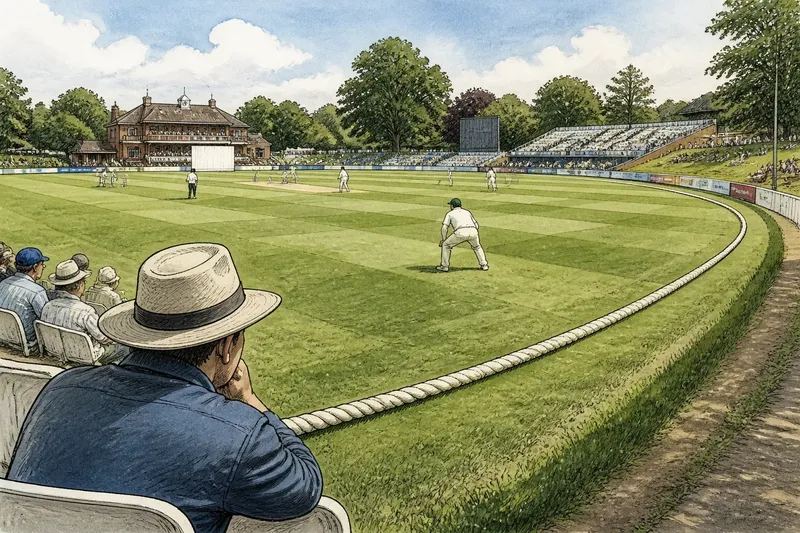
A boundary rope frames the cricket field, but a fence, shadow or strip of worn grass can make its edge hard to follow. Start with the rope’s continuous line, then compare it with the pitch and the fixed features around the ground.
The boundary rope gives the field a readable edge
A spectator follows the ball through the pitch, the close outfield and the deeper field. Beyond the rope lie the venue’s margins: paths, seats, banks or advertising boards. The rope separates those spaces with a line the eye can trace.
That line can matter even when it is not the most striking feature in view. If boards, a low fence or a grass bank make competing lines, the rope needs enough visual separation to remain recognisable. Its curve also gives players and the ball a context: a fielder just inside the rope occupies a different part of the scene from one further into the outfield.
The rope may follow the ground rather than the nearest structure
Grounds have irregular edges. A pavilion, sight screen, access path or seating bank can shape the space available around the field, so the rope may bend where a nearby fence runs straight. The two lines can serve different purposes: one frames the playing area, while the other marks a venue feature.
When a curve looks abrupt from one seat, compare it with the pitch and the outfield rather than judging it against the nearest structure. If another viewing angle is available, check the same section from there. A bend that seems sharp from one side may read as a gradual curve from another.
Contrast helps the eye follow the boundary
A rope can blend into sunlit turf, deep shade or nearby advertising. A dark rope may be hard to distinguish in shadow; a pale one may fade against dry grass. Boards and sponsor markings can add visual noise without showing where the playing edge lies.
For a spectator, the simplest response is to find the section where rope and turf separate most clearly, then trace the line from that point. A higher seat or a small change in viewing angle may help. If the physical boundary remains difficult to see, a ground graphic on the screen can orient you, but it should not be confused with the rope itself.
For those presenting a ground, the aim is clear separation, not extra decoration. A contrasting rope and a clear visual gap from nearby boards can make the edge easier to recognise. Venue staff should follow the instructions that apply to the match rather than improvise around a feature with safety implications.
An obstruction can interrupt the boundary’s visual line
A sight screen, folded cover, steward or equipment can hide a section of rope from a particular seat. When the ball travels towards that part of the field, the missing stretch can make its route harder to judge.
Identify what blocks the view before deciding the boundary is unclear everywhere. If the obstruction is local, another seat may restore the sightline. If it cannot be avoided, use the visible sections on either side to follow the curve; do not substitute a nearby fence or painted mark unless it clearly belongs to the boundary presentation.
Imagine a spectator in a low seat sees the rope disappear behind a temporary screen near deep mid-wicket. They move to an open seat, where the rope is visible continuing in a shallow curve. The improved angle makes the ball’s route easier to follow, without suggesting that the boundary itself has changed.
Nearby marks can resemble the playing edge
A painted line, worn strip of turf or low barrier may sit close to the rope. If it lies inside or outside the boundary, the spectator has to distinguish a ground feature from the edge used for play. Follow the rope’s course around the field, then use the pitch and nearby landmarks to orient yourself.
It is not worth interpreting every patch of turf or painted mark. That adds detail without improving the view. The rope is the clearest starting point; the surrounding features help explain how the field sits within the venue.
What can make the field hard to read?
Why does the boundary look different from each stand?
Perspective changes how a curve appears: from one side it may look rounded, while from another it can seem almost straight. Compare the rope with the pitch and fixed features rather than expecting the same outline from every seat.
What if a fence seems to mark a different edge?
A fence may mark the venue’s limit, protect an access route or sit beyond the playing boundary. Treat the rope as the visible frame of the field, and do not assume the nearest permanent structure sets the edge of play.
How can I follow a boundary that blends into the grass?
Find the point where rope and turf separate most clearly, then trace the curve from there. A different angle or a higher seat may restore the line; a ground graphic can help orient you if the physical view remains obstructed.
Does an uneven curve mean the ground is laid out badly?
Not necessarily. The outline may reflect fixed features and the shape of the venue, while a single viewing angle can exaggerate a bend. Consider the rope across the whole outfield before judging one section alone.
A clear boundary keeps the wider ground in view
The rope should distinguish the playing area without making the rest of the ground disappear. The pavilion, seating, banks and open spaces give the field its setting; the rope’s job is to make the edge readable within that scene.
When the boundary feels confusing, begin at its clearest section and trace the curve. Check what interrupts the view, then compare the line with the pitch and the fixed features around it. That small shift in attention makes it easier to see both where the field ends and how it belongs to the wider ground.