Cricket Bat Shape and Handle: Two Forms in One Object
Cricket bat shape and handle reveal how the blade and grip meet, helping you read a bat’s silhouette and distinguish visible form from playing feel.
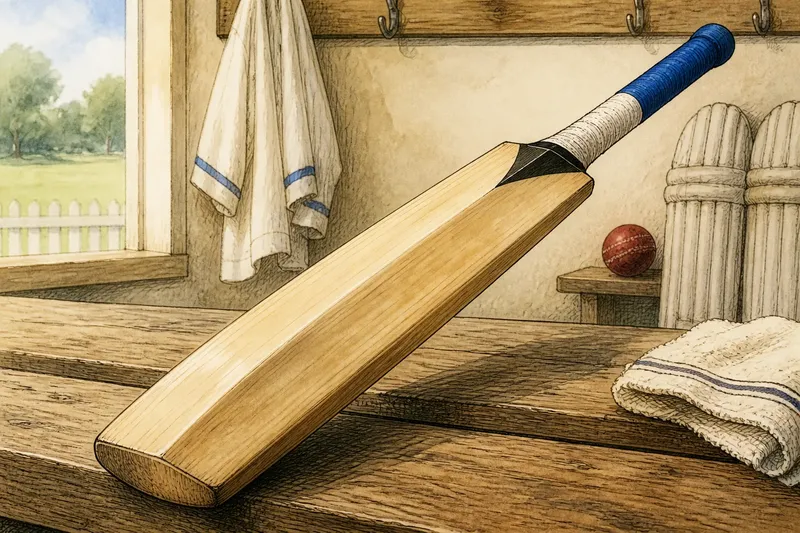
Cricket bat shape is easiest to read where the broad blade narrows into the handle. The blade presents a face and a changing profile; the handle gathers the object into the hands, and their contrast gives a bat its familiar outline.
The blade gives the bat its visible centre
The blade is the bat’s broad, unmistakable body. Its face carries the most obvious visual information: willow grain, the central spine, shoulders and toe all contribute to an impression of weight and direction.
The blade is not merely a flat panel. The spine rises along the back, while the edges and shoulders describe how the wide face narrows towards the handle. Turn a bat in the light and these contours appear and recede, making it seem fuller or slimmer without changing its outline.
This visible centre also gives the bat its recognisable silhouette. A display bat with a clear face and defined shoulders reads quickly as a cricket object, even to someone unfamiliar with its maker or playing history. The broad area invites inspection; the handle completes the outline.
The handle gathers the form into the hands
The handle is narrow beside the blade, but it is not a decorative stem. It provides a point to hold, turn and control, while its grip gives the fingers a textured surface. In visual terms, the narrow section draws the eye from the blade towards the bat’s upper end.
Common handle profiles include round and oval. An oval handle has a more evident front-to-back orientation in the hands, while a round one presents a more even circumference. These are design distinctions, not promises about which shape suits every player; preference depends on grip, comfort and intended use.
The grip also changes the handle’s appearance. A coloured or ribbed covering can make the upper section seem more substantial, while a plain covering leaves more of the wood and splice visible. The grip is replaceable, so it can alter the bat’s look without changing the underlying handle profile.
The shoulders join blade and handle
The shoulders form the transition between the wide blade and narrow handle. A gradual taper can make the object seem continuous, whereas a more pronounced shoulder gives the blade a distinct boundary before the handle begins.
This junction also reveals something about construction. The handle enters the blade at the splice, so the transition is not simply a change in outline: two differently shaped parts meet, each with a separate role. The visible lines and small variations in finish make the bat look assembled rather than cast as one uninterrupted piece.
Say you are arranging a bat for a club display and want its form to be legible from across the room. An unobstructed shoulder and clear blade outline would make the change from face to handle easy to read; a bulky cover over that junction would soften the distinction. The expected result is a display in which both forms remain distinct, without suggesting that either is more important in use.
Visible shape does not settle how a bat plays
The blade’s design is associated with the area and profile presented to the ball, while the handle’s design concerns how the player holds and moves the bat. Terms such as “sweet spot” and “pickup” refer to playing characteristics, not just visible features. A face that looks broad cannot, by itself, tell you how the bat will feel in motion.
When comparing bats in a shop, consider the blade’s profile, edges and spine as visible features, then assess the handle separately for grip shape and comfort. One part cannot stand in for the other: the striking face cannot tell you whether the grip sits naturally in your hands, and a comfortable handle cannot describe the blade’s profile.
For equipment intended for play, suitability depends on the player and the maker’s specifications. If a choice depends on a label, manufacturer instructions or local rules, check those details rather than inferring them from appearance.
Proportion creates the bat’s visual balance
A bat is visually weighted towards the blade because that is where most of its width and surface sit. The handle counters that breadth with a slender line, while the grip adds a patch of colour or texture above it. The parts need not match in size for the whole object to feel coherent.
Balance here is a matter of proportion as much as physical weight. A thick-looking blade paired with a narrow handle can seem purposeful, while a prominent handle may draw attention away from the face. The contrast is part of the bat’s character: its silhouette depends on the difference between a surface built to meet the ball and a stem shaped for the hands.
For a photograph or keepsake display, a side view shows the spine and edge profile, while a face-on view makes the grain and blade outline clearer. Elaborate staging is not worth the effort if the aim is simply to show the bat recognisably; a clear angle that includes both face and handle will usually communicate the object more directly.
What should you look at when comparing blade and handle?
What does the blade’s spine show?
The spine is the raised central profile on the back of the blade, and it shows that a bat is not just a flat piece of wood. Look at how it rises and tapers towards the shoulders and toe to understand the object’s contour.
How does an oval handle differ from a round one?
An oval profile has a clearer orientation in the hands, while a round profile is more even around its circumference. Neither is universally preferable, so the useful question is which shape feels comfortable and manageable to the individual player.
Does a wider-looking face mean a bat will feel heavier?
Appearance alone cannot settle how a bat feels in use. Profile, weight distribution and the player’s own grip all contribute, so treat the face as one visible clue rather than a complete account of pickup.
Why does the grip change the bat’s appearance?
The grip adds colour, texture and apparent thickness to the narrow handle. It can alter the visual transition above the blade, but it does not erase the handle’s underlying shape.
When looking at a bat on a shelf, in a changing room or in a photograph, trace where the blade narrows into the shoulders, then follow the handle upwards. Cricket bat shape becomes legible through that simple contrast: not one undifferentiated tool, but two distinct forms whose meeting gives the object its familiar character.